
Pick the railway for the district
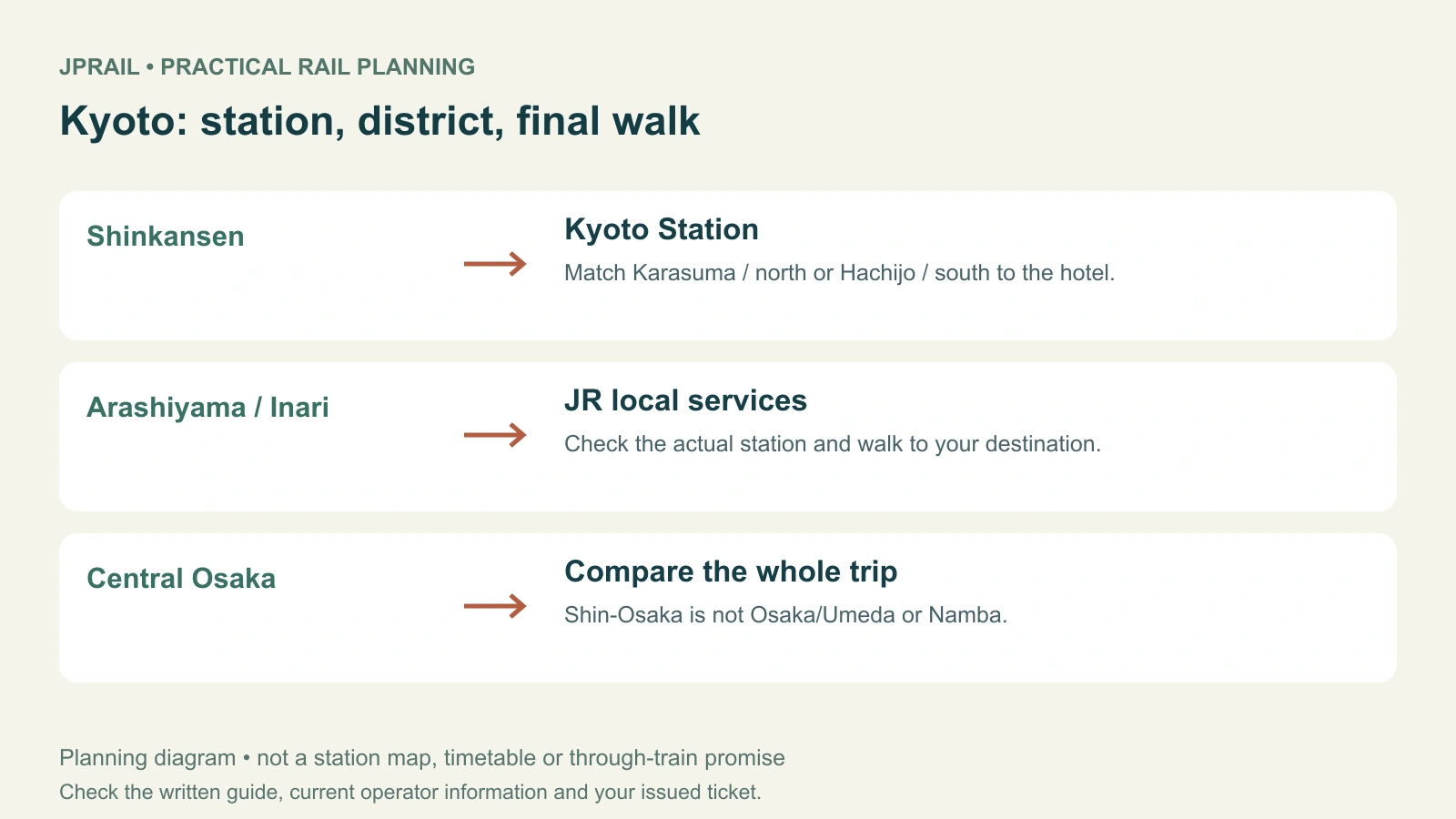
Kyoto Station is useful for Shinkansen and JR local connections, but it is not the centre of every sightseeing district. JR serves Saga-Arashiyama and Inari; the subway and other operators may suit your hotel or a different attraction better. Do not confuse Inari on JR with Fushimi-Inari on Keihan. Check the final walk from the actual station before choosing the route, especially if your accommodation is uphill or on a pedestrian street.
Move luggage before sightseeing
Ask the hotel whether it will hold bags before check-in, and confirm its desk hours. Station lockers are an alternative only if an appropriate size is available. A compact plan is to arrive, store bags, explore one district, and return for check-in. If no storage is available, shorten the sightseeing plan instead of assuming a crowded bus will accommodate several large suitcases. Keep valuables and the items needed during the day with you.
Kyoto to Osaka is a district-to-district decision
A Shinkansen reaches Shin-Osaka, after which most central Osaka hotels need another train or subway. Conventional JR services can suit Kyoto Station to Osaka/Umeda; Hankyu or Keihan may suit a different starting district and destination. Compare the whole journey, including walks and transfers, rather than the fastest train segment alone. A Shinkansen ticket should not be assumed to cover a private railway or subway connection.
Protect the return to Kyoto Station
Choose the return route before travelling to a distant temple district. At busy times, road traffic and bus queues can make a bus connection less predictable than the timetable suggests. Keep enough time to retrieve bags and walk to the Hachijo-side Shinkansen area. Use the current departure board for the final platform and train number; the hotel-to-platform journey ends after the station walk, not at the bus stop.
Main rail gateway
Kyoto Station brings Shinkansen, local rail, subway and bus connections into one large complex.
Arriving and getting into the city
Kyoto Station sits south of many of the best-known historic districts. The north side faces Kyoto Tower and the main city bus area; the Hachijo side is convenient for Shinkansen access. Choose your exit using the hotel address, not just the nearest gate.
A practical first day
Group visits by district. Pair Higashiyama and Gion for a walking day, or use local rail for Arashiyama and spend time beside the river. Fushimi Inari is on a separate local JR route south of the station. Trying to combine all three areas immediately after arriving leaves little time at each.
Where to go next by train
Tokyo and Nagoya are east on the Tokaido Shinkansen; Shin-Osaka is west. For a short trip to central Osaka, compare conventional JR and private railway services as well: the fastest intercity train does not always give the shortest hotel-to-hotel journey.
Local planning tip
Large suitcases are awkward on crowded city buses. Use hotel storage or an available station locker before sightseeing; locker space cannot be guaranteed at busy times.