
Riding the Shinkansen with children is rarely complicated once you understand how Japanese railways classify passengers and how child pricing is built. The decisions that matter — who needs a seat, who needs a ticket, and how to book the family together — are all made before you reach the platform. This guide explains the rules in plain terms, works through two realistic family cases, and gives you a routine you can follow on the day of travel.
Fares and seat availability change by product, season and train, so this guide focuses on the classification and planning logic rather than specific prices.
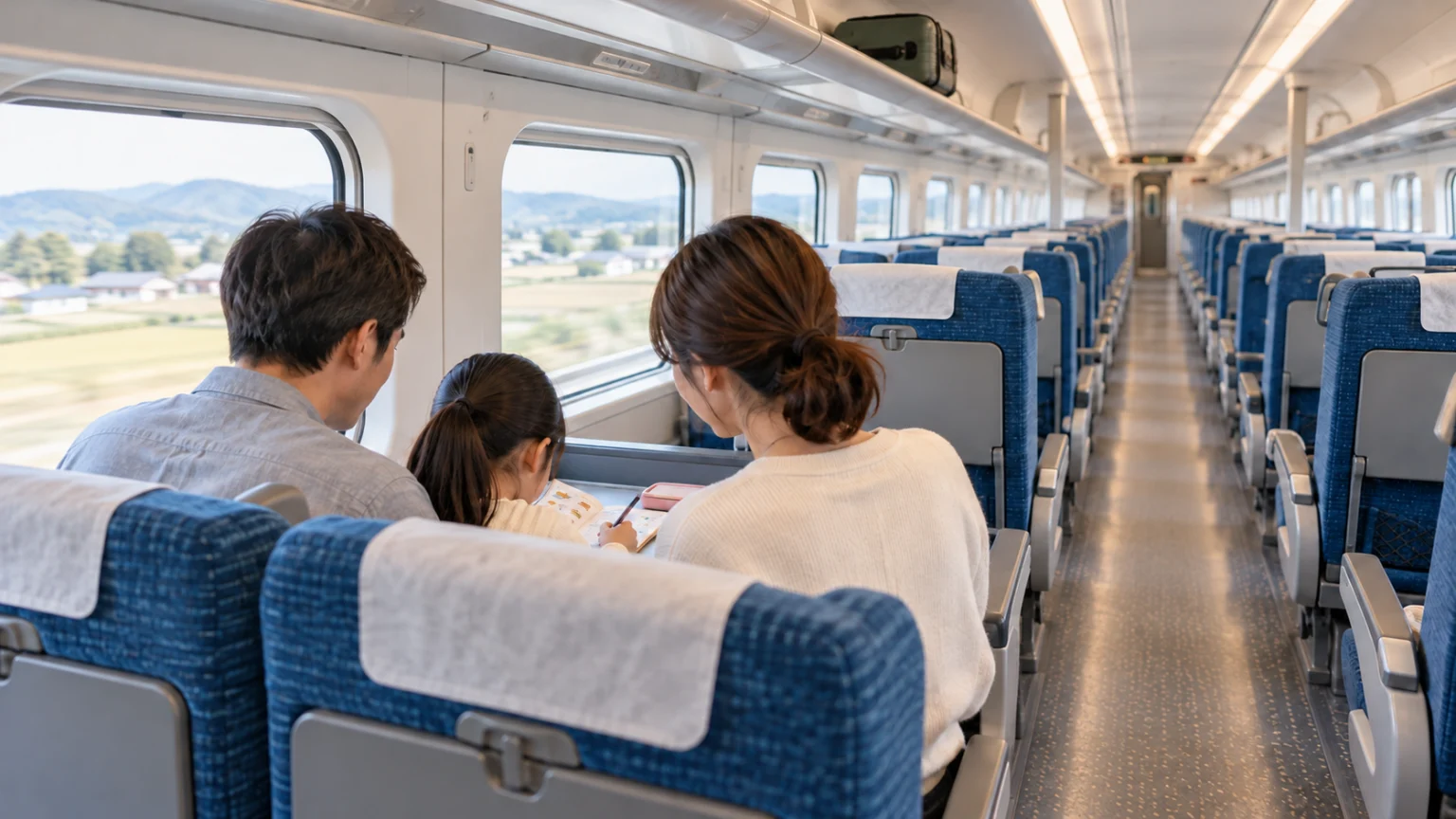
Adult, Child or Infant: The Passenger Categories
Under ordinary JR classification, a passenger aged 12 or over travels as an adult, a passenger aged 6 to 11 travels as a child, and ages 1 to 5 are infants, and a baby under 1 is in the baby category. These categories drive everything else: the fare, the seat, and whether a ticket is needed at all. JR Central's official ticket-type page sets out these categories.
Three practical consequences follow. First, every fare-paying passenger needs their own ticket. Second, a child ticket covers the same journey as an adult ticket — it is not a discount code attached to an adult. Third, the category is about the passenger, not about who buys the ticket: a grandparent, relative or friend can purchase travel for a child.
Age Rules and the Elementary School Exception
Age categories have one narrow exception, and it is tied to Japanese elementary school status, not to school years abroad. A 12-year-old still attending a qualifying elementary school is treated as a child; a 6-year-old who has not yet entered a qualifying elementary school is treated as an infant. These exceptions concern elementary schools established under Japanese law.
Do not map this onto foreign school systems. Grade labels, entry ages and cut-off dates differ by country, and a child who is "Year 6" at home may fall on either side of the JR boundary. If your situation sits near the line, confirm the classification and any evidence required with the operator before you pay, rather than arguing the point at a gate.
Under-Six Travel: Free Travel, Extra Seats and Extra Children
An infant aged 1 to 5 or baby under 1 who travels with an accompanying adult or child, without their own reserved seat, travels free — but only under the operator's conditions, which are not universal promises. Check the wording for the specific product you are buying.
Three situations change the picture. If a third infant travels beyond the two infants permitted per accompanying adult or child, that additional infant incurs a child fare. If an infant travels alone, or if you want them to have their own reserved seat, an appropriate fare is required. And if you are booking through a reservation service, the handling of infants may be described separately — for example, Smart EX's FAQ entry on children and infants explains how these passengers are treated in its reservations.
The key habit is simple: decide for each child individually whether they will hold a seat or travel on a lap, then book accordingly.
How Child Fares Are Built Up
Child pricing is not "half the headline price". The base fare and the limited express fee have child components that are generally halved and rounded. The Green Car supplement is charged at the adult price, and any booking or service fee is not automatically halved.
So a child in a Green Car pays roughly an adult-level supplement on top of halved base and express components. This is why comparing "adult total versus child total" often produces numbers that do not match. Seat categories and what each one includes are covered in our Shinkansen seat classes guide.
Two Worked Family Scenarios
Case A: one adult with three children aged 1 to 5, no own reserved seats
Two infants can travel without their own reserved seats within the accompanying-adult limit. The third infant falls outside that limit and incurs a child fare, even though no reserved seat is requested. In other words, paying for the third child buys a fare, not automatically a seat.
Case B: two adults with one 4-year-old who needs their own reserved seat
Because a seat is wanted, the 4-year-old needs the appropriate child fare, including the child base and express components and the reserved seat arrangement. If the family chooses a higher seat class, remember that the supplement is adult-priced. Two accompanying adults do not change the child's own classification.
Compare the actual party total for your chosen seating arrangement. These examples explain when fares apply; they do not predict which family pays more.
Book the Family as One Group
Search and purchase for the whole party in one flow wherever possible. Splitting the family across separate bookings can increase the risk of separated seating, because adjacent placement depends on what is available when each request is processed.
Choose adjacent seating as a preference, not an expectation — a preference is not a guaranteed seat. Before you travel, open the issued booking and check the actual seat assignments for every fare-paying passenger. If the family is split, decide in advance who travels with each child, and ask the seller about reassignment options rather than moving between cars on board.
Station and Onboard Routine with Children
At the departure station
Plan to arrive roughly 30 minutes before departure as an editorial planning buffer, not as a universal minimum connection. Add more time for lifts and elevators, ticket machines, restrooms, snack stops and crowds, and keep connections flexible so a slow nappy change does not derail the day. Station layouts differ, so see our notes on Tokyo, Kyoto and Shin-Osaka stations before you go.
On board
Keep a small bag at your feet with quiet toys, water, nappies and wipes reachable without opening the overhead rack. If onboard availability of drinks or snacks matters to your plan, buy before boarding. Fold and secure strollers as needed and keep aisles and doorways clear. Do not take another passenger’s reserved baggage space.
Luggage, strollers and accessibility
Adults carry adult-sized bags; children carry what suits them, without assumptions about who should carry what. Ordinary suitcases over 160 cm and up to 250 cm in total external dimensions require the appropriate oversized-baggage seat reservation on the specified lines — see JR Central's oversized baggage information and our Shinkansen luggage guide. Strollers are a special-item category: crossing the suitcase size threshold does not by itself impose the same advance reservation rule. If you want to use a designated reserved oversized-baggage area for a stroller, reserve the appropriate seat. A wheelchair accessible area is not a guaranteed stroller space, so never plan around stowing a stroller there. For onboard rooms and facilities, ask the crew about the multipurpose room; there is no guaranteed nursery, and what is available varies by train and operator.
Tickets, Child IC Cards and Plan Changes
Each fare-paying passenger needs their own ticket. Do not assume that every lap child needs their own QR code — a lap infant without their own fare generally does not, while anyone holding a purchased fare needs their own boarding document. Our e-ticket boarding guide walks through what to prepare.
Child IC cards are a product-specific option, not a version of every adult card. For IC-linked boarding, check whether your ticket product supports a compatible child IC card and how to link it. An ordinary adult card does not automatically apply a child fare. If a child becomes ill or a flight is delayed, contact the seller about product change deadlines as early as possible — a deadline is not a promise of free changes or refunds, and our changes and refunds guide explains the general framework.
Pre-Departure Checklist and Common Mistakes
Checklist
- Confirm each passenger's category (adult, child, infant) before payment
- Decide per infant: lap travel within the free limit, or a purchased fare with a seat
- Book the family in one flow and request adjacent seating as a preference
- Check the issued seat assignments for every fare-paying passenger
- Reserve the appropriate seat for qualifying oversized suitcases; plan stroller storage separately
- Prepare each fare-paying passenger's own boarding document
- Pack quiet toys, water and nappies in a bag kept at your feet
- Build in a planning buffer and keep connections flexible
Common mistakes
- Applying foreign school-year labels instead of Japanese elementary school status
- Assuming the third infant travels free because the family is small
- Expecting child pricing to be half of every fee, including Green Car supplements
- Treating a seating preference as a guaranteed seat
- Blocking the aisle or doors with an unfolded stroller
- Assuming a nursery or specific facility exists on board
Official pages referenced here were checked on 10 October 2026.
Babies under 1 also need the appropriate fare when occupying their own reserved seat. The own-seat exception applies to both the 1–5 infant category and the under-1 baby category. The separate headcount rule charges for the third and each additional infant beyond the two permitted per accompanying adult or child; it is not a limit on the whole family regardless of how many accompanying fare-paying passengers there are.