
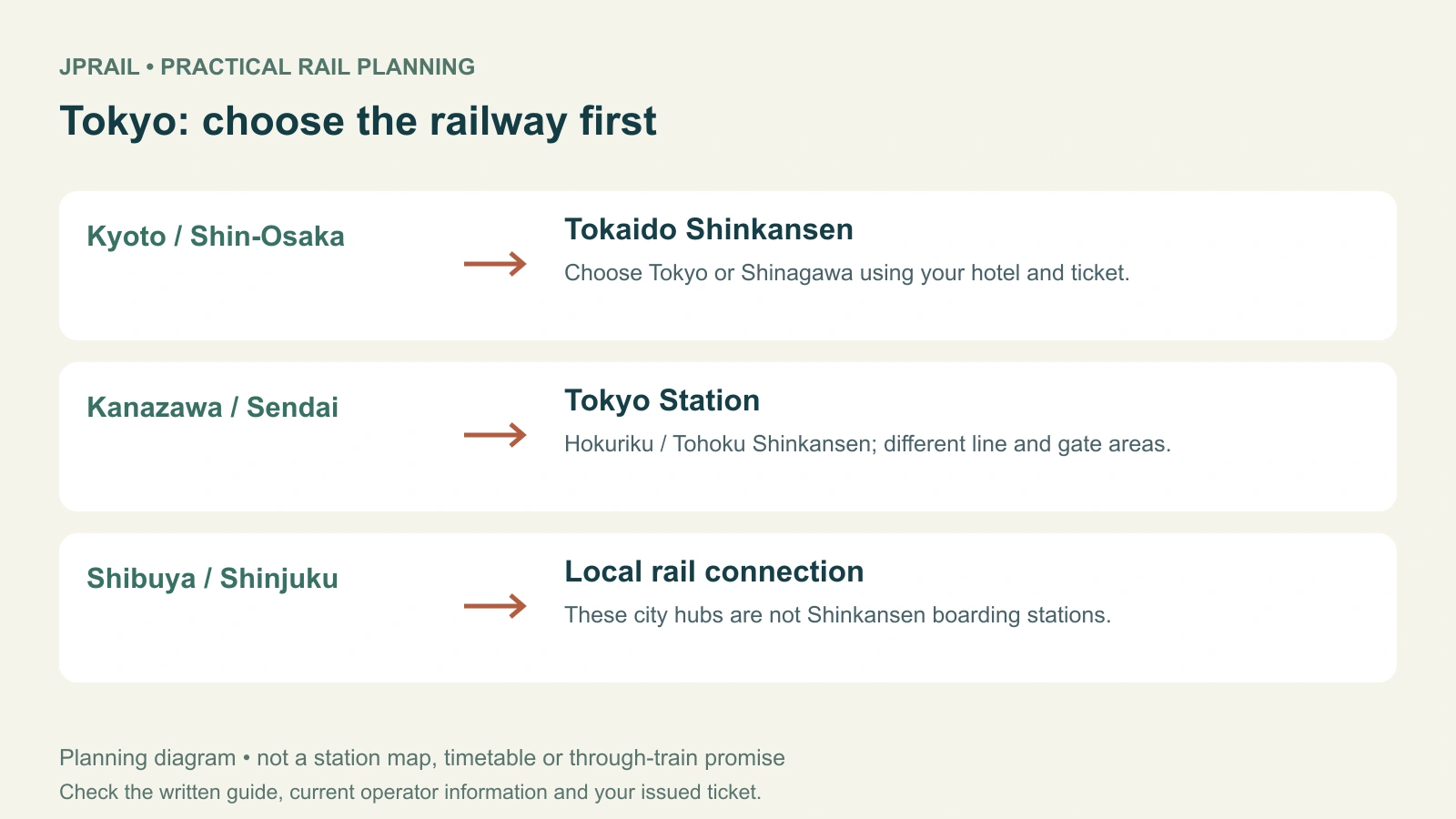
Choose a station from your hotel and next railway
For Kyoto or Osaka, compare Tokyo and Shinagawa against your hotel address before selecting a ticket. For Kanazawa or Sendai, Tokyo is the relevant Shinkansen hub; Shinagawa does not serve those lines. A convenient local station such as Shibuya or Shinjuku is the beginning of a connection, not a bullet-train departure point. Write down the hotel-to-station leg separately so it is not lost when comparing intercity departure times.
Use the operator, then the exit
Tokyo Station has both JR Central and JR East Shinkansen areas. Follow Tokaido/Sanyo signs for Kyoto and Shin-Osaka; use the named northern or Hokuriku line for those destinations. Yaesu and Marunouchi describe opposite sides of the station, not interchangeable meeting points. Agree a named exit outside the gates for a meeting, and check whether a restaurant or shop is inside a paid area before leaving to find it.
Plan an arrival day that still works after a late flight
First finish immigration and collect bags, then choose the airport railway that best reaches your hotel. Do not treat a flight landing time as a reliable start for a tightly timed Shinkansen connection. If you must continue to another city, compare a flexible ticket or an overnight stop with the consequences of missing a restricted departure. Keep your first sightseeing stop near the hotel so a late arrival does not turn into several extra transfers.
A simple departure routine
Save the exact boarding station, line, train number and ticket instructions offline. Plan the local journey in the direction of that station, collect stored luggage, and leave time for ticket collection if required. At the station, check the destination display and train number together: several services can use the same platform. Buy food and water before entering a boarding queue; onboard availability is not a dependable meal plan.
Main rail gateway
Tokyo, Shinagawa and nearby Shin-Yokohama serve different trains and directions.
Arriving and getting into the city
Tokyo Station has two very different sides: Marunouchi faces the Imperial Palace area; Yaesu is convenient for many Tokaido Shinkansen entrances. Shinagawa is another useful Tokaido stop, particularly for south Tokyo. Check the station on your ticket before setting out from your hotel.
A practical first day
Start with the Marunouchi station frontage and the Imperial Palace outer gardens, then choose one area for the afternoon: Asakusa for the old-city atmosphere or Ueno for museums and parkland. Shibuya and Shinjuku are separate urban hubs; crossing the city repeatedly makes a short visit feel rushed.
Where to go next by train
Kyoto and Shin-Osaka lie on the Tokaido corridor. Kanazawa uses the Hokuriku Shinkansen, while Sendai uses the Tohoku Shinkansen. These services can leave from different parts of Tokyo Station, so follow the line name as well as the word Shinkansen.
Local planning tip
A flight arrival is not a reliable train departure time. Allow for immigration, baggage collection, airport transport and the walk to the correct Shinkansen platform.