
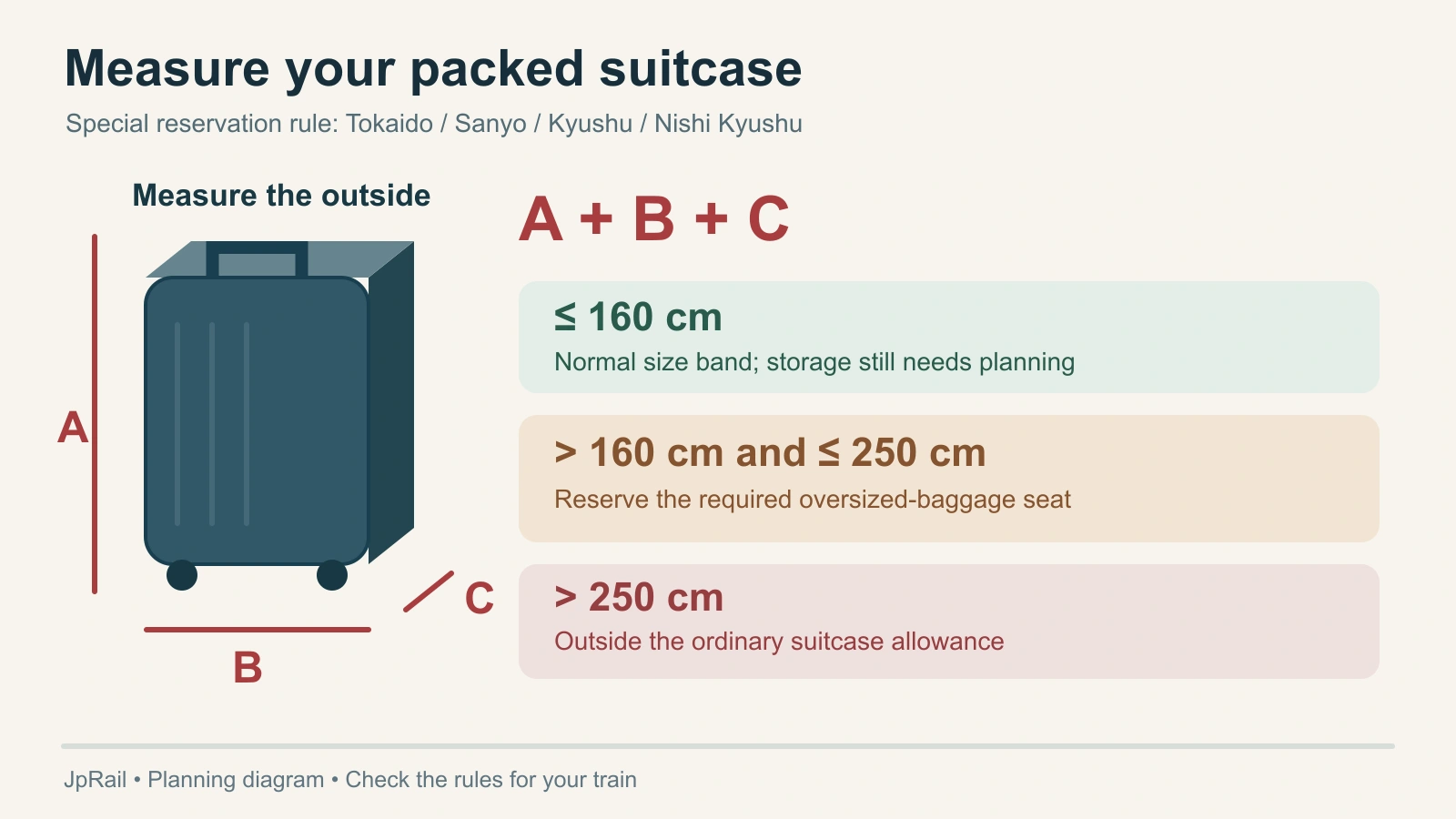
If you are bringing a suitcase on the Shinkansen, the most important step is simple: measure the total of its three dimensions and decide your storage plan before you book. For the Tokaido, Sanyo, Kyushu, and Nishi Kyushu Shinkansen, the key threshold is more than 160 cm through 250 cm in the total of length, width, and height. For an ordinary suitcase in that range, reserve a seat with an oversized baggage area on those lines. Other Shinkansen lines have different storage arrangements; check the operator for your actual route.
Use this guide to decide what to reserve, where to place your suitcase, and what to do if suitable spaces are unavailable.
Measure first: the exact threshold that matters
On the applicable Shinkansen lines, oversized baggage means a bag whose three dimensions add up to more than 160 cm and up to 250 cm. A bag over 250 cm is not allowed as ordinary carry-on baggage under these rules. See JR Central and JR West guidance: JR Central oversized baggage information and JR West luggage guide.
These illustrative measurements show how the boundary works:
- 75 + 50 + 30 = 155 cm: not oversized under this rule.
- 80 + 55 + 35 = 170 cm: oversized under this rule.
- Exactly 160 cm: not oversized under this rule.
- 160.5 cm: oversized under this rule, because it is more than 160 cm.
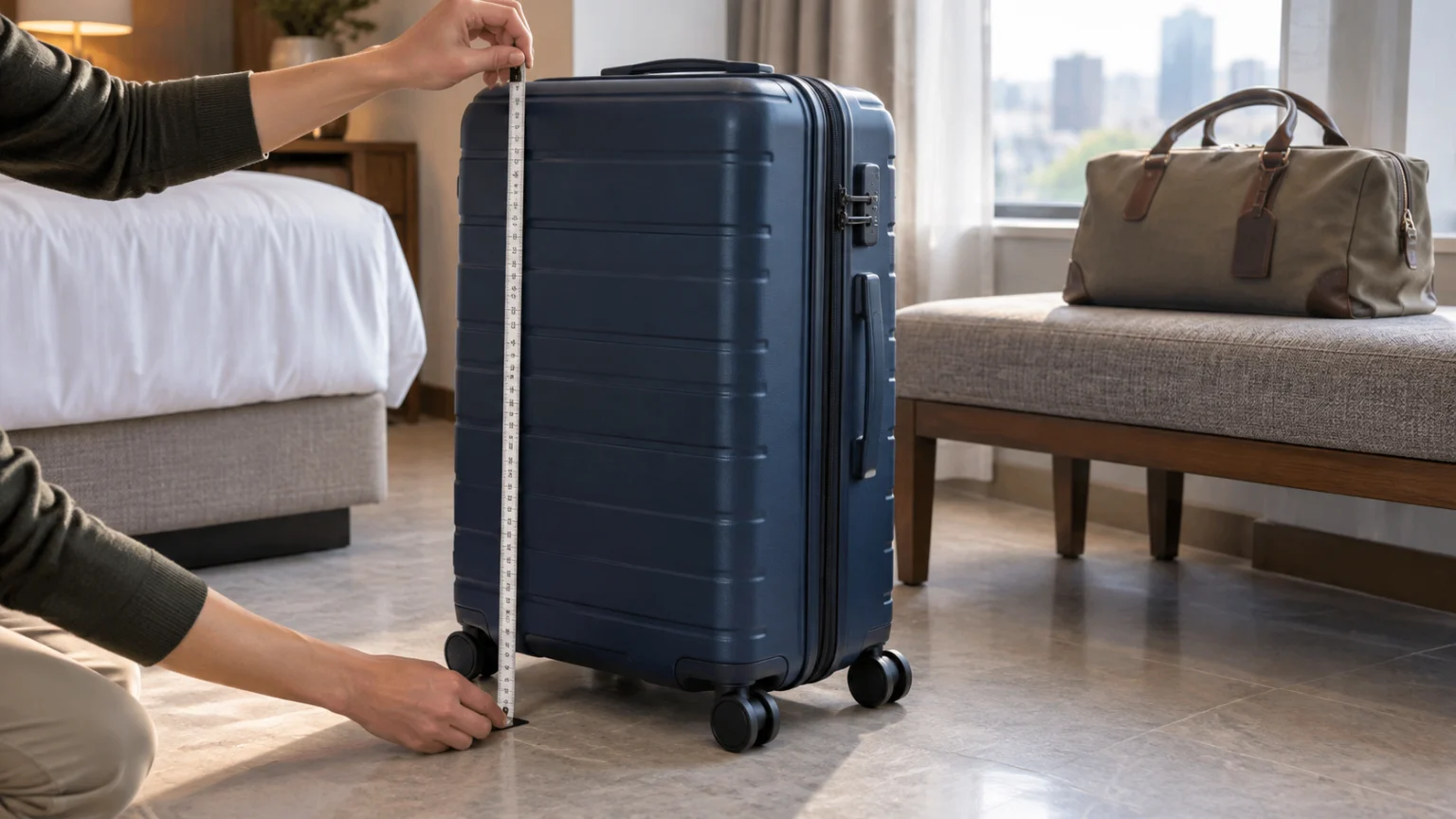
Measure the suitcase itself as packed, including wheels, side feet, handles and rigid protrusions if they affect the outer dimensions. Soft bags can bulge. If your result is near the threshold, treat any figure above 160 cm as oversized and plan accordingly rather than assuming a station staff member will round down.
What you can carry: size, weight and piece limits
Each qualifying baggage item must be no more than 30 kg, its longest side must be no more than 2 m, and the total of the three dimensions must be no more than 250 cm. The basic rule also allows two qualifying baggage pieces per person. Operator pages also note that ordinary personal hand items are treated separately from that count. Source: JR Central personal-belongings rules.
This does not mean two oversized baggage spaces are guaranteed for every passenger. It means the baggage itself can be carried under the general rule if it stays within the operator’s limits. Storage space still depends on your seat reservation, the train, and whether the specific oversized baggage area is available for that departure.
Which space to use for different bag sizes
The practical choice is not just about legality. It is also about whether you can place the bag safely and without blocking others.
Bags at or under 160 cm
Being within the ordinary size band does not guarantee easy storage. Some 160 cm bags are still bulky, heavy, or awkward to lift. Depending on shape and train load, you may use:
- the overhead rack, only if the bag fits and is safe and stable there; do not place heavy or unstable items overhead;
- the space at your feet for smaller cases or soft bags;
- other permitted luggage spaces according to staff instructions.
With children or a stroller, keep essential items in a smaller bag you can reach without opening the suitcase. Read Shinkansen with children as well, because family boarding flow matters as much as raw dimensions.
Bags more than 160 cm through 250 cm
The designated area is associated with particular reserved seats, commonly at the rear of a car. Check the issued arrangement and use that space; an empty area behind another row is not automatically yours to occupy.
JR West's current notice describes a trial allowing some deck storage without reservation. This does not remove the reservation requirement for oversized suitcases. Do not assume every train has that deck facility, or treat it as a backup for a 170 cm case.
How oversized baggage seat reservations actually work
The seat tied to the oversized baggage area is sold at the same operator reserved-seat price as a normal reserved seat; there is no extra operator baggage-area fee on that basis. Source: JR West luggage guidance.
That does not mean every reseller shows the same price structure, service fee, or booking flow. It also does not mean every booking channel supports every baggage-related seat request.
When booking on JpRail:
- Check whether the baggage option is displayed during booking.
- If it is displayed, treat it as a request or selection step, not a final confirmation until ticket issuance is completed and the issued booking details reflect it.
- If the option is not displayed and you need it, ask support before payment. Do not assume it can be added later.
- Do not book an ordinary reserved seat and plan to settle the issue on the platform.
Check the seat and baggage arrangement in the issued details. A paid order or a baggage request alone is not proof that suitable space has been secured. Compare the offered seat classes if your preferred option is unavailable.
If you are using digital tickets, our Shinkansen e-ticket boarding guide is useful for understanding what to verify before you reach the gate.
Multi-train trips: check every leg separately
On multi-leg journeys, check each train separately. Your first leg may have an oversized baggage seat available while the second does not. The baggage rule follows the train you board, not your overall itinerary intention.
Illustrative example: Tokyo to Kagoshima-Chuo with a 170 cm suitcase
Illustrative planning example only. A traveller with one 170 cm suitcase chooses an itinerary involving a change of train. They should verify the correct arrangement for each applicable leg, not just the first departure. If the first train has suitable space but the second does not, consider these options:
- Change to a different departure with the proper baggage arrangement;
- Send the suitcase ahead using a verified forwarding service if suitable;
- Repack into smaller compliant pieces if possible and still within the ordinary item rules.
What if the eligible baggage seats are full?
Ordinary seats may still be on sale when the baggage-eligible seats are full. Check the specific baggage option, not just a general “seats available” message. The SmartEX reservation guide explicitly distinguishes these inventories.
Without the required reservation, the operator charges a baggage fee of ¥1,000, including tax, and the crew specifies where the bag must be stored. Paying this fee does not reserve space in advance. Reserve the correct seat or choose another departure with suitable space.
If your travel day involves a tight station transfer, a different departure may be much less stressful anyway. For station layouts and transfer walking considerations, see Tokyo, Kyoto and Shin-Osaka stations.
Special items: strollers, instruments and sports equipment
Some bulky items are treated differently from the ordinary oversized suitcase rule, but if they are to use a designated oversized baggage area, a reservation is still required under the operator framework. Source: JR West luggage guide.
Strollers, musical instruments and sports equipment have item-specific conditions. Check those conditions, including required packing, rather than applying the ordinary suitcase rule to every object. Wheelchair travel and assistance should be arranged separately with the relevant operator.
Record the packed size and whether you need the designated rear-seat area when asking about a special item. Folding a stroller helps with handling but does not give you the right to occupy another passenger's reserved luggage space. Keep doors and aisles clear.
Forwarding luggage to your hotel: when it is the better choice
Forwarding may be useful when your suitcase is difficult to lift or the itinerary involves several transfers. Compare the delivery arrangements before cancelling a suitable baggage-seat plan.
Do not promise yourself same-day delivery unless your hotel, service counter and route explicitly confirm it. Ask about collection cutoffs, excluded items, delivery estimates and what happens if the suitcase is delayed.
Hotel forwarding checklist
- Ask your hotel whether they can receive forwarded luggage for your check-in date.
- Confirm the name on the reservation and the correct hotel address format.
- Check whether the service point accepts your bag size and weight.
- Ask when delivery is expected; do not assume same-day.
- Keep valuables, medication, travel documents and one change of clothes with you.
- If you will arrive before the suitcase, plan what you need for that gap.
Compact station checklist before boarding
Use this quick check on travel day:
- Reconfirm the suitcase measurement total.
- Check which leg, if any, requires the oversized baggage arrangement.
- Make sure the issued reservation matches what you intended to book.
- Separate valuables and items needed during the ride.
- Plan enough walking and lift time for each transfer; do not assume one fixed buffer works at every station.
- Know your car number and boarding position before you reach the platform.
Sources
- JR Central: Oversized baggage information
- JR West: Train usage guide for luggage
- Smart EX: Oversized baggage guidance
Official sources checked 10 October 2026. Recheck the rules for your route before travel, especially storage trials and special items.
Private cabins need their own storage check
Selected trains now offer Supreme Class cabins with specific baggage arrangements. Do not assume their storage matches an ordinary or Green seat, or that every cabin has the same external baggage area. If booking this product through a supporting channel, check the cabin-specific storage dimensions and conditions in JR Central's baggage guidance. JpRail availability must be confirmed separately.